Invoices
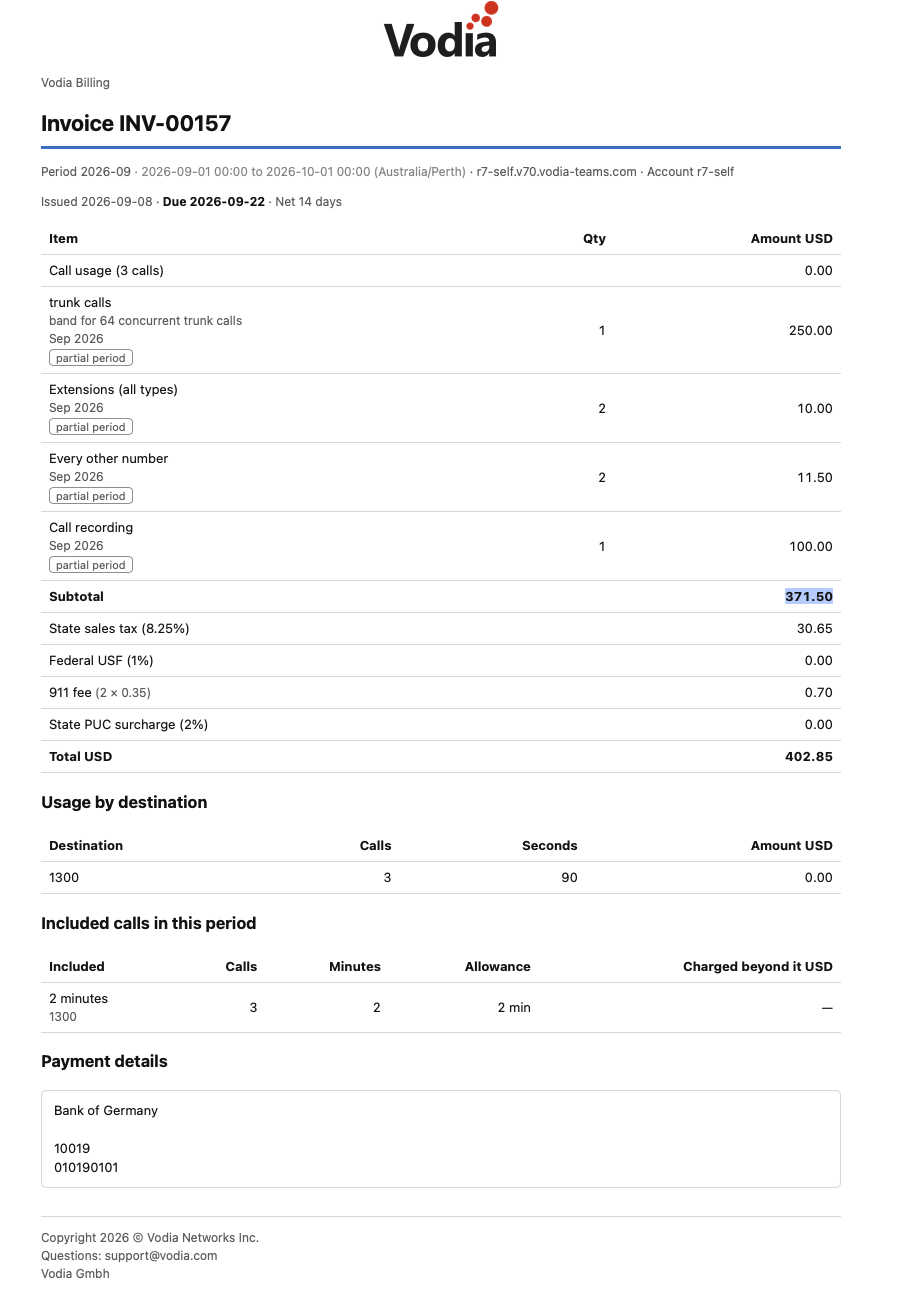
An invoice is issued to a customer, not to a site. Where a customer covers several sites, all of them appear on one document, each as its own section with its own subtotal, and the totals, tax, discounts and credits are computed once for the whole party.
Every tenant belongs to a customer, and a tenant that has never been grouped is a customer of one — which produces the same single-section document, with no section headings, that a per-tenant invoice always did.
A site belonging to a multi-member customer cannot be invoiced on its own. Draft and finalize both refuse it and name the customer to bill instead.
Lifecycle
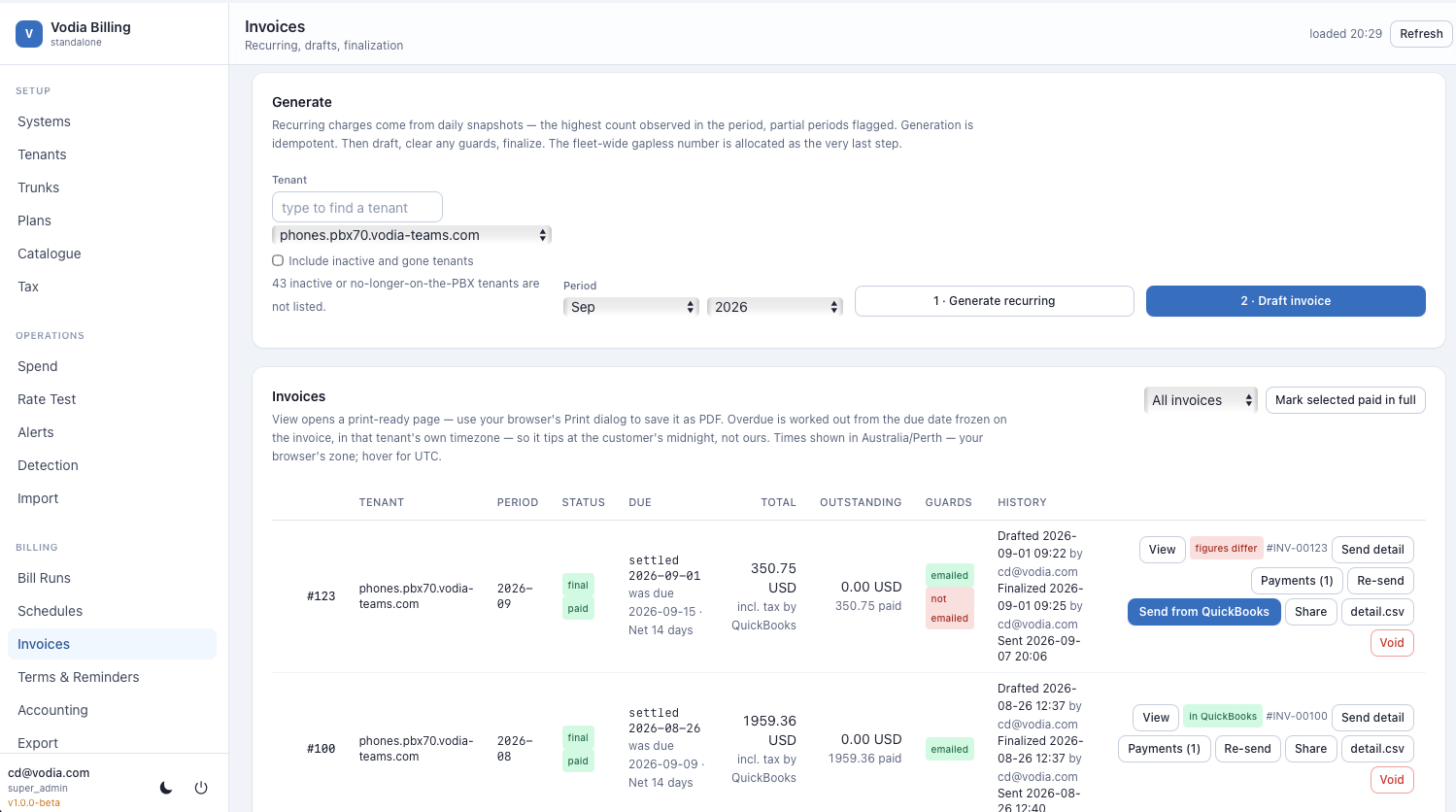
An invoice moves through four states.
Draft — generated for a period. Recurring charges are created from snapshots, usage is gathered, tax is computed, guards are evaluated. A draft can be regenerated freely and holds no invoice number.
Finalized — the invoice is fixed. It receives its number, its detail is frozen, and it becomes the document you send.
Sent — emailed to the customer's billing recipients, or handed to the accounting package that emails it.
Void — cancelled. The number is retained. Any credits applied to it are restored.
Guards
Finalization is blocked, per site, by any of these:
- Unreviewed trunks with traffic in the period
- Unrated legs — calls that matched no rate row
- Unapproved one-time charges
- Unpriced recurring subtypes — an entity type with no rate at any frequency
- No billing recipients, when the run is set to email
- A duplicate invoice for the same period
- A sibling invoice already pushed to the accounting package
Guards are evaluated for every member of a customer, and one blocked member blocks that customer's whole invoice. Issuing the rest without it would under-bill silently. The run names the member and the guard that stopped it.
Blocked customers are reported and skipped. They never stop the rest of the run and never consume an invoice number.
Guards are re-checked at finalization, not just at draft time, so a blocker that appeared in between still stops that customer.
Numbering
Invoice numbers are fleet-wide and gapless. There is one sequence across every tenant and every system.
The number is allocated as the last step of a successful finalization. A failure part-way through therefore does not burn a number. A void retains its number, because a gap in a numbered sequence is an accounting problem and a voided document is a legitimate record.
Because the sequence is gapless, bill runs finalize tenants sequentially rather than in parallel.
Periods are cut on call start
An invoice period includes a call if the leg started inside it, not if the call was rated inside it.
This matters in three places. Archive recovery imports rate calls today that happened last month, and they must land on last month's invoice. An invoice must be reproducible from the same rule that produced it. And the frozen call detail must agree with the totals above it.
Frozen detail
At finalization, the invoice's line summary, inclusion summary and call detail are frozen onto the invoice document. Later changes to rate sheets, tax profiles or plan configuration cannot alter an issued invoice.
Inbound calls appear in the frozen call detail with no amount, so a customer can see the call happened without being charged for it.
Templates and languages
Settings → Templates holds the invoice template library. Each template carries branding, business identity, footer text and a language.
Thirteen languages are supported: English, Catalan, German, Greek, Spanish, Finnish, French, Italian, Japanese, Dutch, Portuguese, Russian and Turkish. Translation falls back to English per key, so a partially translated template renders rather than showing blanks.
Assign a template per customer. A customer with none inherits the default.
Share links
Each invoice can carry a share link: a URL the customer can open to see the invoice and its call detail without logging in.
- Invoice-scoped, so one link exposes one invoice
- Revocable at any time
- Audited on creation and on revocation
- Carries no cost and no margin data, ever
Invoice emails include a link to the call detail derived from the share URL, so the customer can drill into the calls behind a usage line.
Paying online
Where Stripe is configured and the customer is unbound and switched on, the share page carries a Pay now button. It rides the same share token — there is no second public URL with different rules — and eligibility is re-evaluated on every page load, so a button that would not work is never drawn.
The button asks for what is outstanding, not the face of the document, so a credit or a recorded cheque since finalization is already reflected. The emailed invoice itself carries the share link rather than the button; an invoice email never contains script of any kind.
PDF
Print the invoice page from the browser. There is no separate PDF renderer, and browser print output is what the invoice layout is designed against.
One-time charges
Raised per tenant, priced from the Catalogue or entered directly. One-time charges must be approved before they appear on an invoice; an unapproved charge blocks finalization rather than being silently dropped.
One-time charges fall in the goods tax bucket.
Reclassifying a call
Spend → reclassify re-rates a single leg against any destination on the tenant's sell plan. This is the "mark as international" case: a number the sheet priced as national that should not have been.
The original rating is preserved on the record and the change is audited. It is refused once the call has been invoiced, because at that point the invoice is the document and changing the call underneath it would make the two disagree.
Voiding
Voiding an invoice retains its number, restores any credits that were applied to it, and is audited. An invoice already pushed to an accounting package must also be voided or credited there; Vodia Billing does not reach into the accounting package to reverse it.
A payment that came from Stripe cannot be unapplied by hand: deleting it would claim the customer never paid while their statement says otherwise. Refund it in the Stripe dashboard instead, and the reversal arrives as its own ledger row.
Worked examples
A finalized invoice
INVOICE INV-00151                        Northwind Telecom
                                         1 Example Plaza, Seattle WA
Bill to:  Acme Corp                      Tax ID 00-0000000
          NW-1041
                                         Issued:  2026-09-01
Period:   2026-08-01 to 2026-08-31       Due:     2026-09-15

USAGE
  US National              1,240.00 min   0.012        14.88
  United Kingdom              86.00 min   0.035         3.01
  UK Mobile                   12.00 min   0.14          1.68
  US Toll Free (inbound)     318.00 min   included      0.00
                                                    --------
                                                       19.57

RECURRING
  Extensions                      42      12.00       504.00
  Hunt groups                      3       5.00        15.00
  DID numbers                     18       1.50        27.00
  Managed support plan             1     150.00       150.00
                                                    --------
                                                      696.00

ONE-TIME
  Desk handset                     1      89.00        89.00
                                                    --------
                                                       89.00

                                     Subtotal         804.57
                                     Sales Tax 8.25%   66.38
                                     USF 1%             0.20
                                     PUC 2%             0.39
                                     911 Fee x45       15.75
                                                    --------
                                     TOTAL    USD     887.29

1,338 calls in this period. Full call detail: <share link>
Inbound calls appear with no amount, so the customer sees the traffic without being charged for it. Full arithmetic in Worked Example.
Reading the blockers on a draft
Draft: hq.northwind-example.com  2026-08
  BLOCKED (3)
    unreviewed_trunk    carrier-secondary  (412 legs, 1,204 min)
    unrated_legs        7 legs to prefix 351
    unpriced_recurring  attendant (2 instances, no rate at any frequency)
  not_due (1)
    Annual licence — billing month September
Three blockers and one note. The not_due line is not a problem: an
annual charge outside its billing month is reported so you can see it exists.
Each blocker has one fix:
unreviewed_trunk    -> Trunks: classify carrier-secondary
unrated_legs        -> Plans: add a destination for prefix 351 (Portugal)
unpriced_recurring  -> Plans -> Recurring: add a rate for `attendant`
Numbering across a run
Bill run 2026-08, finalize stage
  hq.northwind-example.com      INV-00151   887.29     sent
  branch.northwind-example.com  BLOCKED — no recipients
  west.northwind-example.com    INV-00152   1,204.60   sent
  east.northwind-example.com    INV-00153   531.40     SEND FAILED (SMTP timeout)
  south.northwind-example.com   INV-00154   642.15     sent
Note what happened to the numbers. branch was blocked at prepare and
consumed none. east finalized successfully as INV-00153 and then failed
at the send stage, so its number and its invoice both stand — only the email
failed. A tenant that failed during finalization would have consumed no
number at all, because the number is allocated as the last step of a
successful finalization.
Retrying the run re-sends only east, because send state is per invoice.
A void
INV-00151   887.29   VOID   2026-09-03  (wrong tax profile applied)
            credit of 50.00 restored to Acme Corp
The number is retained. A gap in a numbered sequence is an accounting problem, and a voided document is a legitimate record. The credit that had been applied comes back and can go on the replacement invoice.